Your electric car already does a lot. It gets you from Keperra to the CBD without burning a drop of fossil fuel, and it charges up overnight while you sleep. But what if it could do something even more useful, like power your home during the evening peak, straight from the solar energy it soaked up during the day?
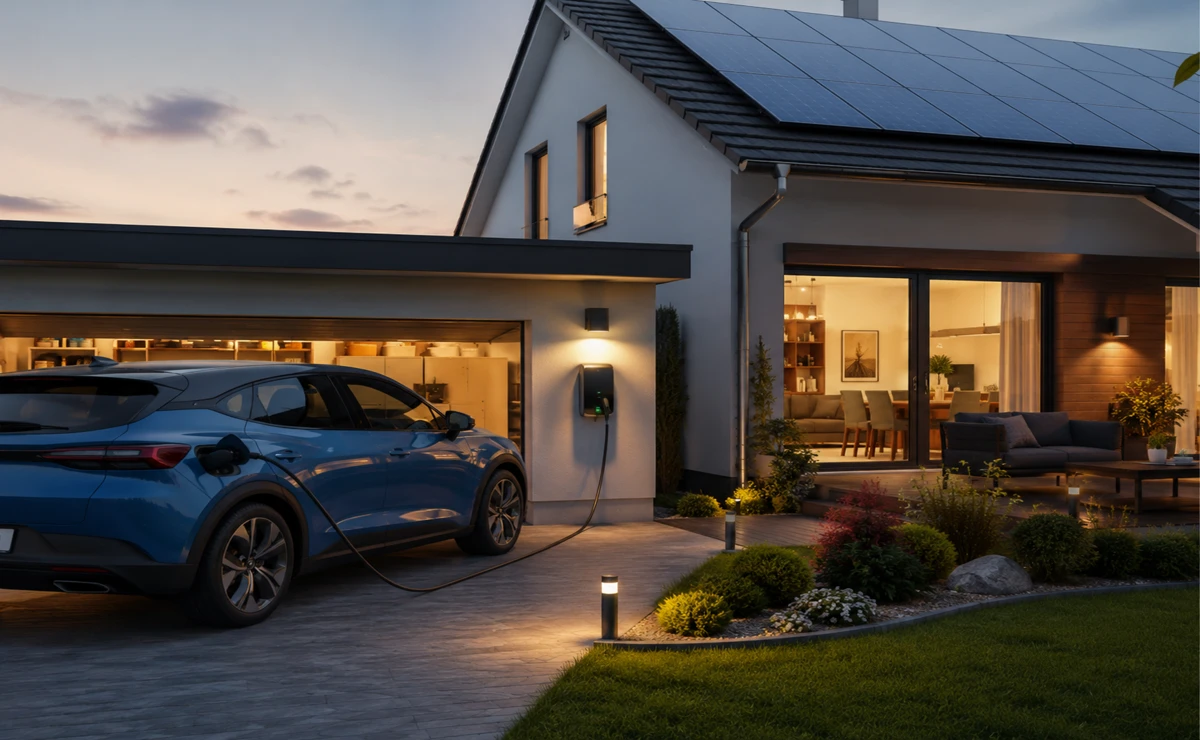
That’s the idea behind vehicle-to-home charging, which lets your EV battery push stored energy back into your house. This technology works alongside your solar panels to cut how much grid electricity you need.
More Brisbane homeowners are starting to ask about this, and with good reason. Queensland’s solar output is among the best in the country, and pairs well with a smart EV setup. This guide will show you how it works and what it takes to make it part of your home. Let’s get into it.
What is Vehicle-to-Home Charging?
Vehicle-to-home (V2H) charging is a system that lets your electric car act as a large home battery that you can also drive to work. Instead of just pulling power from the grid, your EV battery stores energy and sends it back into your house when you need it most.
That’s the flexibility that makes V2H interesting. Your car does its normal job during the day and moonlights as a home battery at night.
The part that surprises most people is just how much stored energy a typical EV battery holds. Honestly, many modern electric vehicles carry enough capacity to run a Brisbane household for a full day or more.
Bidirectional EV Charging: How the Two-Way Power Flow Works

Bidirectional EV charging allows your car to act as a backup power source for your home. Let’s break down the main pieces that make it all work.
The Role of Bidirectional Chargers
The charger itself is where most of the technical heavy lifting happens. A few things worth knowing before you start comparing models:
- The Hardware Itself: Bidirectional chargers are the physical units that manage two-way power flow between your EV and your home. Unlike a regular EV charger that only pushes electricity in one direction, these units handle both.
- Cost and Availability: They cost more to buy and install than a standard EV charger. Only a handful of brands currently offer full V2H functionality in the Australian market, so your options are still limited now.
- Clean Energy Council Approval: Not every bidirectional charger on the market is approved for use in Australia. Looking for Clean Energy Council accreditation is a good way to make sure the unit you choose meets local safety and grid integration standards.
Bidirectional chargers are still a new product in Australia, but more options are coming onto the market each year as EV ownership climbs.
What Your Electric Car Needs to Support It

Not all electric vehicles are built equally for sending power back to your home, so compatibility is the first thing to sort out. Some older EV models don’t have the onboard systems required for bidirectional charging, but plenty of newer ones do. That’s why it pays to check compatibility before you commit to buying a charger or planning an install.
The Nissan Leaf is one of the well-known V2H-capable EVs in Australia, along with a growing number of newer models. To support V2H, a vehicle must also meet certain hardware requirements. DC charging compatibility is a factor here, since V2H relies on DC power conversion to work properly.
Your EV’s battery management system also needs to handle two-way energy transfer without affecting battery life gradually. This is one of the reasons not every EV supports the feature, even if the manufacturer offers a bidirectional charger separately.
So, choose the right combination of car and charger first. Once those two are in place, a qualified installer can easily handle the rest of the setup.
Vehicle-to-Home vs Traditional Battery Storage: Which One Wins?
You can compare V2H with a dedicated home battery across seven main factors that affect cost, performance, and long-term usability. Each of these factors influences which option best fits your home and energy needs.
The table below highlights the main differences:
|
Feature |
V2H (EV Battery) |
Home Battery (e.g. Powerwall) |
|---|---|---|
Primary purpose |
Driving + energy storage |
Energy storage only |
Battery capacity |
40-100kWh (larger) |
10-15kWh (smaller) |
Cost |
Charger install only |
Full unit + install |
Reliability for home use |
Moderate |
High |
Battery longevity |
May wear faster |
Designed for daily cycling |
Australian market availability |
Limited |
Widely available |
Grid integration |
Possible with right setup |
Standard |
The comparison highlights a simple trade-off. A dedicated home battery like Tesla Powerwall is purpose-built for storing excess solar energy and cycling daily without wearing down quickly. Your EV battery often provides far more capacity, but manufacturers designed it primarily for driving.
If your electric car supports bidirectional charging and sits in the driveway most of the day, it’s a cost-effective alternative to buying a separate solar battery.
Could This Change Your Energy Consumption at Home?

Yes, the effect on your daily energy consumption can be pretty significant. Peak times, usually between 4 pm and 9 pm, are when grid electricity costs the most. In this setup, your solar panels charge the EV battery during daylight hours. Once the sun goes down, that stored energy flows back into your house instead of pulling from the grid.
Running your home off your car’s battery during those hours means you’re pulling less power from the electricity grid, and that shows up directly on your power bills.
Have a quick look at what’s involved:
Electricity Tariffs, Feed-in Rates, and the Real Savings Picture
Feed-in Tariff Rates for sending excess solar power back to the electricity network have dropped steadily across Australia over the past few years. Besides, self-consumption, using what your solar system generates, has become the savvy plan for most households.
In practice, using stored EV energy during peak hours can reduce your electricity bills. The savings won’t look the same for every household. That depends on your energy use patterns, including the electricity providers you use. For homes with solar panels already installed, the numbers are worth a closer look.
Where Does the Energy Transition Stand in Australia Right Now?
Australia’s energy transition is well underway. The Australian Renewable Energy Agency reports that rooftop solar is now installed onmore than 4 million homes nationally, and EV registrations keep climbing every quarter.
So the country is moving away from traditional energy sources and fossil fuels very quickly. However, vehicle-to-grid and vehicle-to-home technology are still in early stages across the Australian market, though the pace is picking up.
Several energy companies are running V2H andV2G pilot programmes to test how these systems perform in real households across the national grid. At the same time, Clean Energy Council guidelines are also evolving to keep up with growing demand for renewable energy storage.
Brisbane and Electric Vehicles: Are Local Homeowners Ready for This Shift?
EV charging infrastructure is expanding across the city, but dedicated bidirectional charger installations are still rare. The shift is still in its early stages, but the direction is becoming clearer.
To understand what this means, look at EV adoption and solar trends in Southeast Queensland, along with what homeowners need to get started.
EV Adoption and Solar in Southeast Queensland

Southeast Queensland has one of the highest rooftop solar penetration rates in the world, which gives EV owners a natural advantage for solar charging. This strong mix of renewable energy and V2H-ready EVs is already helping households move toward greater energy independence. It also reduces their dependence on the grid each quarter.
As more EVs with bidirectional charging enter the market, this advantage will continue to grow across the region. For a closer look at how solar benefits homeowners in the region, see the benefits of solar power for your home.
What Local Homeowners Need to Get Started
Your existing solar system needs to be large enough to charge your EV during daylight hours and still cover your home’s baseline energy use. Many local households may need a system upgrade, so it makes sense to assess your current setup first.
What’s more, connecting a bidirectional charger to the Queensland electricity grid involves approval from local electricity providers and compliance with single-phase standards. EV battery and charger compatibility is also worth sorting out early, since not every unit works with every car on the market.
An accredited installer will know exactly what Brisbane’s grid integration requirements are for your specific car and solar setup.
Quick Note: Local governments and energy companies are still working through the regulatory side of this, so confirm current requirements with a qualified installer.
Ready to Rethink What Your Driveway Can Do?
Brisbane homeowners with a decent solar setup and the right EV are already well-positioned to make vehicle-to-home charging work, and the technology is getting more accessible.
The path to self-sufficiency needs a few main pieces to line up first:
- Your EV battery must support bidirectional charging
- The solar system needs to generate enough excess energy to cover both driving and home power needs
- A compatible bidirectional charger installed by an accredited local installer
- Your home’s connection to the electricity grid needs to meet current Queensland standards
Get those four things sorted, and that’ll reduce reliance on traditional grid power and cut your energy bills. At My Solar Power Brisbane, we can help you figure out solar system sizing, pick the right bidirectional charger, and get your home set up for V2H properly.
Reach out today, and let’s work out what your setup needs to make it happen.